Robin has boundless energy in cool weather, but in the heat he's a different dog. Earlier in the summer, I reviewed Alcott's cooling bandana, and we also purchased him a Ruffwear Swamp Cooler cooling vest, one of the most popular dog cooling products. Unlike the Alcott bandana, which is filled with cooling beads, the Swamp Cooler uses evaporative cooling: it's made of an absorptive material that slowly releases water to evaporation after a soaking. The evaporating water takes body heat with it, keeping the dog cool.
Fit: 4/5 Robin is between sizes in Ruffwear gear: his Approach pack is an XXS, while his climate changer is an XS, and both fit him almost perfectly. His Swamp Cooler is an XS, but it fits him a little loosely. Bigger is better on a product like this one, so we chose the XS for good back and side coverage. However, the belly panel of the XS vest is a little wide for Robin's chest, and water plus friction equals irritated skin: by the time we realized what was happening, he had scabs in both armpits. Fortunately, a temporary hair band fix works well to keep the vest away from his front legs. I do have to monitor the positioning of the hair band, which slipped on a recent hike and gave him a new set of blisters, but it helps me pin down the correct spot for a permanent sewn fix.
Design: 3/5 The vest is comprised of an absorptive core, a gray mesh lining and a tough, fine mesh light gray shell. The absorptive core soaks up a fair amount of water but doesn't hold it as well as I hoped- I expected it to be a highly technical layer that locked in and slowly released water, but maybe that is beyond today's technology. Instead it's more like a big sopping wet sponge- any pressure on the vest causes water to drip out even after being wrung out. Oddly enough, the outer layer isn't very absorbent, so it's hard to re-wet the vest using a hydration pack on the trail since the water just runs off. The open weave of the shell and liner allows sand to become trapped inside the vest, which never seems to rinse out fully. The inner liner also picks up foxtails, which become lodged in the absorptive core and have to be threaded back out.
The vest is cut for full coverage, and and fastens simply with one buckle on either side. The buckles are positioned deeply between two flaps of the vest to prevent accidental skin pinching, and it's sometimes hard to get them fastened on an unhappily damp dog. There's one small strip of reflective piping on the chest, which is sufficient since it's rarely hot enough at night for a cooling vest. Subtle trim and stitching gives the vest a clean, understated look. Once Robin forgets his displeasure, the vest doesn't impede him at all- it allows a full range of motion and never shifts to the side.
Function: 4/5 Robin actually is not too happy to see this vest come out, but he forgets about it shortly after it's put on. I think he dislikes the feeling of something wet being put over his head. While the Swamp Cooler doesn't completely negate the effects of hot weather, it significantly cuts back on his panting, to the extent that I wouldn't take him hiking in summer without it. I typically carry it in a plastic bag to the trailhead, and put it on there so that he'll quickly forget in the excitement of hiking. This strategy works well because the vest leaves wet patches and drips anywhere Robin goes for the first ten or fifteen minutes of wear.
We get about 1 to 1.5 hours of wear out of the vest before it's mostly dry, and the biggest drawback is that it's hard to re-wet. In drought-stricken SoCal we don't have an abundance of water along the trail, and since the shell is slightly moisture resistant it tends to shed small quantities of water dribbled from a hydration pack. In more humid climates, the evaporation would be slower, but the vest might be less effective overall since the evaporation is what makes it cool.
There's no doubt that it works: his fur under the vest is cool to the touch.
Durability: 5/5 The vest looks almost new after a whole summer of dust, mud and foxtails, except for some dust stains on the belly, and it rinses pretty clean no matter what Robin gets himself into. There are a few snags on the inside where foxtails were trapped, but each time I wash it up after a hike I'm amazed by how clean it gets.
Overall: 4/5 The vest has become a can't-live-without-it product for us. Despite its sand/foxtail and re-wetting drawbacks, it's been indispensable throughout this 90-110 degree summer and we've definitely done some hikes that would have been impossible without it. It's definitely on the expensive side at $59.95, but I was able to find one on sale for around $35 and would begrudgingly purchase another at full price if I needed a replacement.
Takeaways:
Good for: Any outdoor activity in warm or hot weather- this is now a mandatory product for us for any hot-weather hiking. The difference is night and day.
Not ideal for: May be less effective on very humid days.
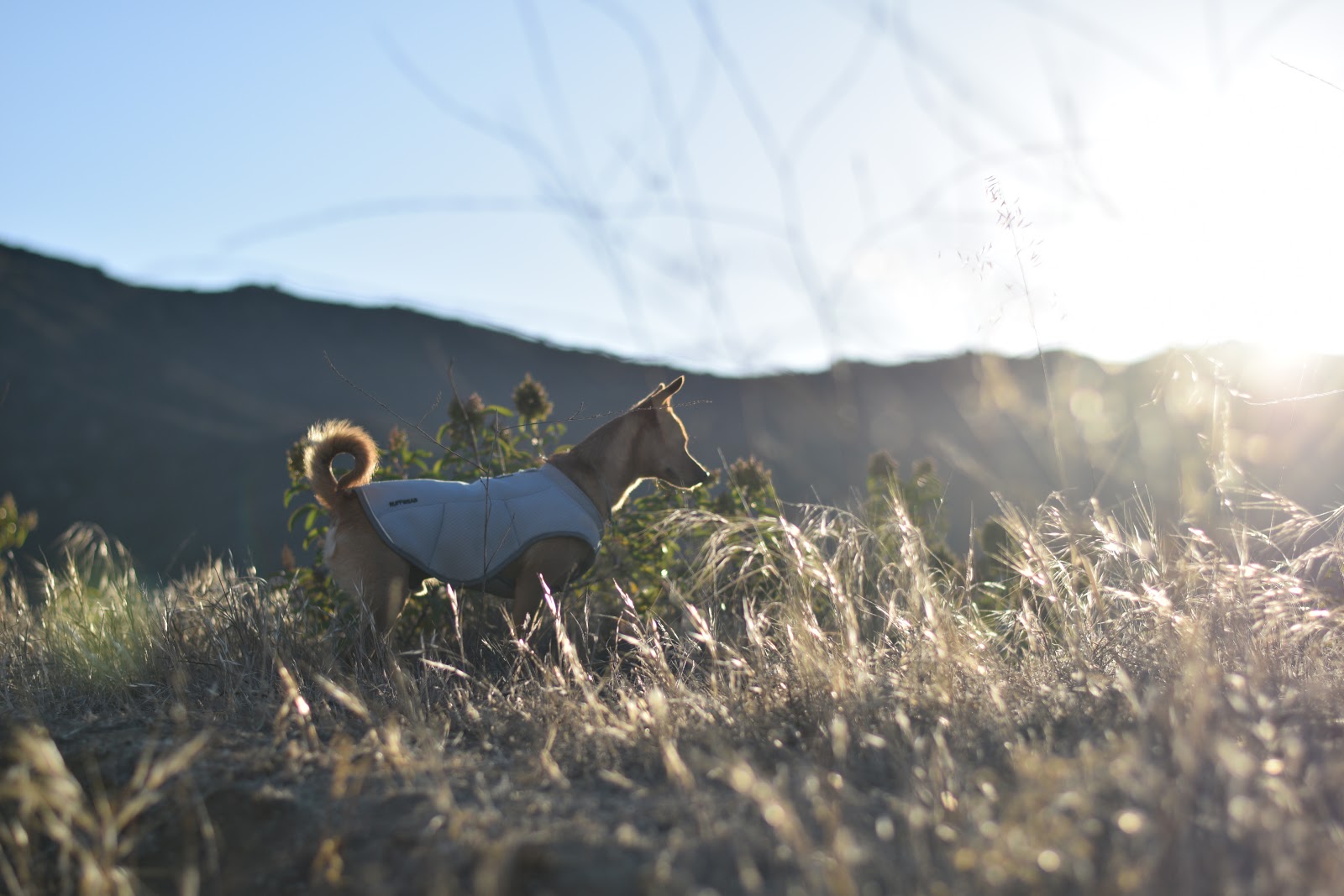 |
| Robin stalking the sun in his cooling vest |
Fit: 4/5 Robin is between sizes in Ruffwear gear: his Approach pack is an XXS, while his climate changer is an XS, and both fit him almost perfectly. His Swamp Cooler is an XS, but it fits him a little loosely. Bigger is better on a product like this one, so we chose the XS for good back and side coverage. However, the belly panel of the XS vest is a little wide for Robin's chest, and water plus friction equals irritated skin: by the time we realized what was happening, he had scabs in both armpits. Fortunately, a temporary hair band fix works well to keep the vest away from his front legs. I do have to monitor the positioning of the hair band, which slipped on a recent hike and gave him a new set of blisters, but it helps me pin down the correct spot for a permanent sewn fix.
 |
| A hair band around the belly panel of the vest keeps it from rubbing Robin's armpits |
Design: 3/5 The vest is comprised of an absorptive core, a gray mesh lining and a tough, fine mesh light gray shell. The absorptive core soaks up a fair amount of water but doesn't hold it as well as I hoped- I expected it to be a highly technical layer that locked in and slowly released water, but maybe that is beyond today's technology. Instead it's more like a big sopping wet sponge- any pressure on the vest causes water to drip out even after being wrung out. Oddly enough, the outer layer isn't very absorbent, so it's hard to re-wet the vest using a hydration pack on the trail since the water just runs off. The open weave of the shell and liner allows sand to become trapped inside the vest, which never seems to rinse out fully. The inner liner also picks up foxtails, which become lodged in the absorptive core and have to be threaded back out.
 |
| No range of motion loss here. |
 |
| Robin attempting to "shake off" the vest's dampness on a brutally hot day |
We get about 1 to 1.5 hours of wear out of the vest before it's mostly dry, and the biggest drawback is that it's hard to re-wet. In drought-stricken SoCal we don't have an abundance of water along the trail, and since the shell is slightly moisture resistant it tends to shed small quantities of water dribbled from a hydration pack. In more humid climates, the evaporation would be slower, but the vest might be less effective overall since the evaporation is what makes it cool.
There's no doubt that it works: his fur under the vest is cool to the touch.
 |
| Addison re-wetting Robin's vest with his CamelBak |
Durability: 5/5 The vest looks almost new after a whole summer of dust, mud and foxtails, except for some dust stains on the belly, and it rinses pretty clean no matter what Robin gets himself into. There are a few snags on the inside where foxtails were trapped, but each time I wash it up after a hike I'm amazed by how clean it gets.
Overall: 4/5 The vest has become a can't-live-without-it product for us. Despite its sand/foxtail and re-wetting drawbacks, it's been indispensable throughout this 90-110 degree summer and we've definitely done some hikes that would have been impossible without it. It's definitely on the expensive side at $59.95, but I was able to find one on sale for around $35 and would begrudgingly purchase another at full price if I needed a replacement.
Takeaways:
Good for: Any outdoor activity in warm or hot weather- this is now a mandatory product for us for any hot-weather hiking. The difference is night and day.
Not ideal for: May be less effective on very humid days.


