Showing posts with label Ruffwear. Show all posts

Gear Review: Ruffwear Roamer convertible leash

Disclaimer: I purchased this product at a discount through BackcountryK9 as a result of my relationship with them. It normally retails for $34.95 and comes in medium and large and in red, purple, blue and black.

The Roamer in use at sunrise.
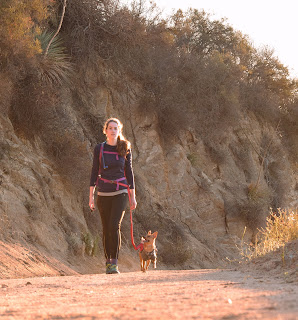
Prior to this, I've never actually bought a leash. Robin's main leash was a length of artfully knotted paracord that he recently destroyed when I moved outside of his comfort radius. Because he has great recall and sticks close on the trail, he's generally only leashed on familiar trails when we spot another dog. So when I recently signed up to do a volunteer park cleanup, I realized I'd need a decent, hands-free leash - but I didn't anticipate how much I'd use this leash now that I have it!

Jason at BackcountryK9 made a couple of leash recommendations for me, but I picked the Roamer because of its overengineered all-metal hardware and sleek design. Robin's not a strong puller and I know we'd never break the plastic buckle on the EzyDog Road Runner (his follow-up recommendation) or similar leashes, but I like to invest once in something that will last pretty much forever. The lack of a plastic buckle at the waist also reduces the bulk when it's hand-held.

Design: 5/5

The leash is quite simple: it's a single piece of webbing with a little gray loop at one end and a sturdy winged clip at the other, and a sliding metal hook allows you to adjust from a hand loop up to a 48" waist. The waist hook fastens through the end webbing loop, which was almost impossibly tight for the first few uses. This wasn't a problem for me (I'd just loosen and step out if I ever had trouble), but the only negative reviews on Ruffwear's site complained about this. Even now that it's softened up slightly, there's zero chance of it ever unhooking itself- the hook is designed with an extra lip on the bottom that keeps the strap firmly in place. The handle is padded, which I find unnecessary but then I only use it for waist wear. The whole thing in size medium weighs 130g or 4.59 oz on my scale, which isn't extremely light but is pretty reasonable for such a substantial leash.

The sturdy metal waist clip

A generous section of the webbing is elasticized (Ruffwear calls it "Wavelength") to reduce shock on both human and dog and to extend the range. It's worth noting that the size Large gives significantly more range than does Medium - when adjusted for hand-held use, the medium stretches from 5.5' to 7', while the large stretches from 7.3' to 11' (a 50% increase). I specifically wanted the leash for times that I need Robin close, but if your dog isn't reliable off-leash or you have a larger waist, the large size might be a good option. Just bear in mind that there will be extra slack between you when your dog is close by (and if your dog is the type that gets wrapped around poles, you might be in trouble!) With the medium and my ~28" waist, there's enough extra for some flexibility but the leash can't drag on the ground.

The clip on the dog end is a hefty looking swivel winged claw clip ("Talon Clip") that's lightweight for its size. I was concerned that it would be far too heavy to attach to his lightweight martingale collar, but it actually worked fine the time I had to. Robin did some thorough yanking and twisting on the clip when I tethered him at the volunteer event after he broke the carabiner on his previous leash. He's not strong, but can be tricky with the way he twists himself up and got out of a similar clip in his early days.

The lightweight clip isn't even tightening Robin's martingale.
(Tethering via collar is very much not recommended! In this case, I had to pop inside the visitor center and he could see me through the front window.) 

I would like to see some reflectivity on the leash. It would also be nice to see some type of bypass for the stretch other than the traffic handle (which is useless with a 14" tall dog), but I can't picture how this would work without adding a lot of bulk or moving parts.

Fit: 5/5

While the hefty 3/4" size medium is definitely overkill for 17lb Robin, I actually don't find it too heavy and barely notice it around my waist. The webbing is sturdy but lightweight, and the clip is much, much lighter than it looks. I've used it on his collar several times and it doesn't seem to drag on his neck too badly. For waist leashes (where your attention is typically occupied elsewhere) it's always going to be better to use a harness to avoid jolting the neck and throat.

Function: 5/5

Previously, my issues with leashes stemmed from having one more thing to hold. My daypack has no external pockets for quick stowing, and when in use, holding the leash affected my stride when running or hiking. With this leash, I clip it on and forget about it until we see a leashed dog. Even better, I love the security of having the dog attached to my waist for all kinds of outings. I took Robin to an outdoor concert last week and enjoyed focusing on the music without thinking about keeping track of him. Next up is seeing if we can manage it and trekking poles.

One concern I had was that gaining more ground via the stretch section would encourage Robin to pull. We've worked extensively on loose leash walking and don't want to set back his training. So far, this hasn't been a problem- he doesn't really use the extra range except when he gets really excited or is sniffing off the sidewalk. However, I still imagine that this could become a problem and for that reason I make a distinction between collar use and harness use. When it's clipped to his collar, I treat it like a normal leash and expect him to slow down as soon as he feels any tension. When it's clipped to his harness (and he's less sensitive to tension in the line anyway), I am much more relaxed about him wandering as long as he doesn't trip me.

Build quality: 5/5

Like pretty much everything Ruffwear makes, it's ruggedly built and overengineered, but with streamlined style. On this style of leash, the most likely failure points are the hardware (which in this case is all-metal and extremely sturdy) and the elastic section.

Because the entire leash is one piece of webbing, with the stretch section just shirred up with internal elastic, failure is a non issue. I appreciate that there are no extra odds and ends (the EzyDog leash has an extra loop and toggle and the OllyDog version is doubled up for extra adjustability, which just means more bulk and more failure points). The Roamer keeps it simple.

One end of the stretch section- there is no seam, just reinforcement where the internal elastic ends.

Overall: 5/5

I really like this leash and reach for it constantly, no matter where we're going. So far it's been perfect for hiking, concerts, walks, airport security- pretty much everything. The medium is a perfect size for keeping Robin close, and I love the red because I can quickly find it in my bag or the depths of the car. If we lost this leash I would definitely get a second one. 


Takeaways

Best for: Universally a great option for runners, hikers, or anyone that walks a dog and would like to have free hands.

Not ideal for: High-risk/high traffic scenarios where tight control is needed and extended range could be dangerous; nighttime use when range/lack of reflectivity could pose a problem, times when an ultralight/ultra packable leash would be needed.

Updates: 
Dec 28: added numerical ratings. 
Gear Review: Ruffwear Swamp Cooler

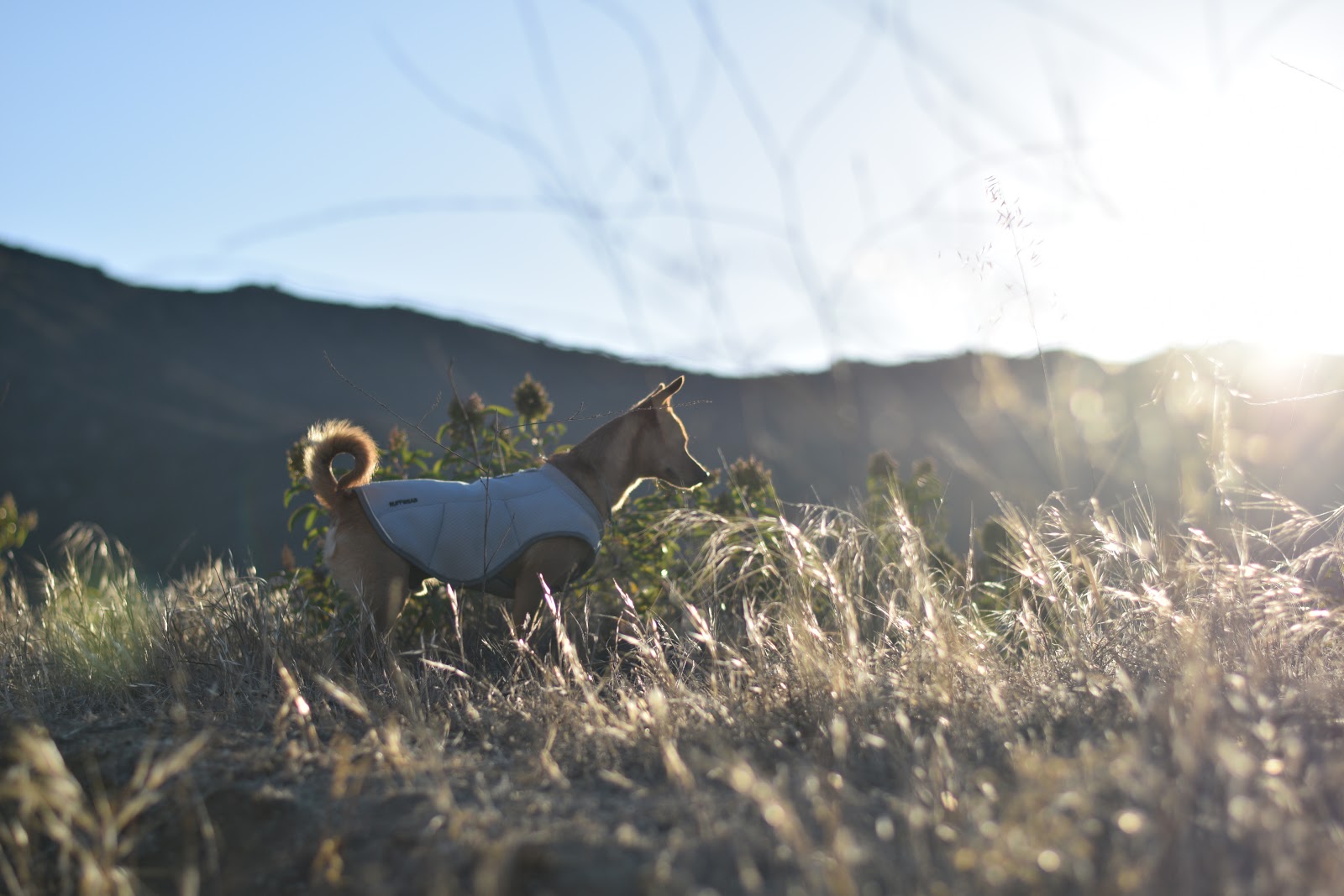
Robin has boundless energy in cool weather, but in the heat he's a different dog. Earlier in the summer, I reviewed Alcott's cooling bandana, and we also purchased him a Ruffwear Swamp Cooler cooling vest, one of the most popular dog cooling products. Unlike the Alcott bandana, which is filled with cooling beads, the Swamp Cooler uses evaporative cooling: it's made of an absorptive material that slowly releases water to evaporation after a soaking. The evaporating water takes body heat with it, keeping the dog cool.

Robin stalking the sun in his cooling vest

Fit: 4/5 Robin is between sizes in Ruffwear gear: his Approach pack is an XXS, while his climate changer is an XS, and both fit him almost perfectly. His Swamp Cooler is an XS, but it fits him a little loosely. Bigger is better on a product like this one, so we chose the XS for good back and side coverage. However, the belly panel of the XS vest is a little wide for Robin's chest, and water plus friction equals irritated skin: by the time we realized what was happening, he had scabs in both armpits. Fortunately, a temporary hair band fix works well to keep the vest away from his front legs. I do have to monitor the positioning of the hair band, which slipped on a recent hike and gave him a new set of blisters, but it helps me pin down the correct spot for a permanent sewn fix.

A hair band around the belly panel of the vest keeps it from rubbing Robin's armpits

Design: 3/5 The vest is comprised of an absorptive core, a gray mesh lining and a tough, fine mesh light gray shell. The absorptive core soaks up a fair amount of water but doesn't hold it as well as I hoped- I expected it to be a highly technical layer that locked in and slowly released water, but maybe that is beyond today's technology. Instead it's more like a big sopping wet sponge- any pressure on the vest causes water to drip out even after being wrung out. Oddly enough, the outer layer isn't very absorbent, so it's hard to re-wet the vest using a hydration pack on the trail since the water just runs off. The open weave of the shell and liner allows sand to become trapped inside the vest, which never seems to rinse out fully. The inner liner also picks up foxtails, which become lodged in the absorptive core and have to be threaded back out.

No range of motion loss here.
The vest is cut for full coverage, and and fastens simply with one buckle on either side. The buckles are positioned deeply between two flaps of the vest to prevent accidental skin pinching, and it's sometimes hard to get them fastened on an unhappily damp dog. There's one small strip of reflective piping on the chest, which is sufficient since it's rarely hot enough at night for a cooling vest. Subtle trim and stitching gives the vest a clean, understated look. Once Robin forgets his displeasure, the vest doesn't impede him at all- it allows a full range of motion and never shifts to the side.

Robin attempting to "shake off" the vest's dampness on a brutally hot day
Function: 4/5 Robin actually is not too happy to see this vest come out, but he forgets about it shortly after it's put on. I think he dislikes the feeling of something wet being put over his head. While the Swamp Cooler doesn't completely negate the effects of hot weather, it significantly cuts back on his panting, to the extent that I wouldn't take him hiking in summer without it. I typically carry it in a plastic bag to the trailhead, and put it on there so that he'll quickly forget in the excitement of hiking. This strategy works well because the vest leaves wet patches and drips anywhere Robin goes for the first ten or fifteen minutes of wear.

We get about 1 to 1.5 hours of wear out of the vest before it's mostly dry, and the biggest drawback is that it's hard to re-wet. In drought-stricken SoCal we don't have an abundance of water along the trail, and since the shell is slightly moisture resistant it tends to shed small quantities of water dribbled from a hydration pack. In more humid climates, the evaporation would be slower, but the vest might be less effective overall since the evaporation is what makes it cool.

There's no doubt that it works: his fur under the vest is cool to the touch.

Addison re-wetting Robin's vest with his CamelBak

Durability: 5/5 The vest looks almost new after a whole summer of dust, mud and foxtails, except for some dust stains on the belly, and it rinses pretty clean no matter what Robin gets himself into. There are a few snags on the inside where foxtails were trapped, but each time I wash it up after a hike I'm amazed by how clean it gets.

Overall: 4/5 The vest has become a can't-live-without-it product for us. Despite its sand/foxtail and re-wetting drawbacks, it's been indispensable throughout this 90-110 degree summer and we've definitely done some hikes that would have been impossible without it. It's definitely on the expensive side at $59.95, but I was able to find one on sale for around $35 and would begrudgingly purchase another at full price if I needed a replacement.

Takeaways:
Good for: Any outdoor activity in warm or hot weather- this is now a mandatory product for us for any hot-weather hiking. The difference is night and day.
Not ideal for: May be less effective on very humid days.

Gear Review: Keeping Warm in the Backcountry with the Ruffwear Climate Changer


Even in balmy Southern California, it gets chilly at night, especially in the mountains. I generally avoid putting clothes on Robin except when weather necessitates it, but for his first backpacking trip, I knew a packable but warm jacket would be a necessity.

I've had the fleece Ruffwear Climate Changer in mind for a cool-weather layer, and finally snapped it up on sale just in time for our trip. Here's our experience:

Chilly camp morning - Mt Lowe Trail Camp

Fit: At an 18.5" girth, 14.5" back length, 12" neck circumference, Robin fits an XS like it was made for him. The length is ideal and his curly tail doesn't fold the jacket back. It's a tiny bit roomy in the chest and belly, which makes it easier for him to run around. Potty clearance is perfect. Reviews on Ruffwear's site are all over the place fit-wise, so apparently we got lucky with Robin's body type.


Chest view of the jacket

Design: The zipper is an elegant solution compared to the velcro closures on most dog clothing, and it never unzipped by itself. The athletic cut is flattering and the reflective piping is surprisingly visible at night. It's hard to find dog clothing with sleeves and these are well-executed. The fleece is thin but dense and feels like it will resist pilling. If there's anything to nitpick, I was disappointed that the trim on the triangular zipper flap at the neck isn't too durable- I snagged it the very first time I unzipped the jacket. The cover could be cut back farther to reduce zipper interference.

This is the first time I've ever gotten him something in gray when it came in orange, but I didn't like the shade of orange on his fur, and the orange color seemed to emphasize the bagginess.

Robin awaiting his breakfast from my hammock - Mt Lowe Trail Camp

Function: I'd heard stories of this jacket keeping dogs warm down to 40 degrees, but they must have more hair than Robin. Nighttime temperatures were probably just below 60 degrees in our camp. He stayed warm on top of my sleeping bag for most of the night with just the Climate Changer, but by morning he was chilled and didn't stop shivering until he finished breakfast.

The jacket brushed remarkably clean of dirt and leaves. However, it's shedding season so the inside is hairy, and the hair doesn't come off as easily. Since Robin doesn't shed for most of the year, I'll wait and remove it with tape.

Packability: The XS Climate Changer weighs about 3.5 oz and packs into one side of Robin's XXS Approach pack with room to spare. Fleece doesn't compress too well, but the efficient cut makes it relatively small when packed.  It's thin enough to fit under his pack if we ever go hiking in freezing weather.

The XS rolled jacket takes up just over half of the 1L bag on his XXS pack.
Takeaways:
Good for: Trim body types, keeping bald chests and bellies warm, a baselayer under a pack or heavier jacket.

Not ideal for: Extreme temperatures without a top layer, bulky or muscular body types, zipper chewers.


Updates: 
06/07/2015 added packed size and chest fit photos

Gear Review: Tubular White Pine collars and pet safety considerations

Midleap - Cherry Canyon
Although nowadays Robin is rarely leashed, his collar is a critical safety tool.  We tried a few options before settling on the perfect one.

In the beginning, he was skittish enough that he wore a Petco "adjustable mesh harness" and a comfort collar for walks, just in case. Unfortunately, his coat started to break underneath the harness's tight neckline, and the bulky padded collar crumpled his neck hair. I decided to look into martingale collars, which tighten only when tension is applied.  Though often used as a training aid in place of a chain, when they are adjusted generously martingales have the benefit of fitting loosely until control is needed.

(We still have his Petco harness and use it for kick-scooter trips and the occasional hike.  It's well designed out of stretchy, durable mesh, and while it's far from an attractive harness we've found it to be very secure.)

Having just purchased a Ruffwear pack, I decided to get a Ruffwear Chain Reaction collar in size small (11-14" neck).  Ruffwear must have based the size chart on larger-headed dogs, because Robin at 11.5" (now 12") was just barely able to slip out of its smallest adjustment.  Although I determined that the collar's range could be extended by removing the sewn on rubber logo tag holder, we ended up returning it once we noticed further damage to his hair.  The twisting of the collar's sturdy webbing against his fur caused a new ring of breakage around his neck.

While researching hair breakage, I happened upon White Pine collars, which are chainless slip collars made of silky tubular nylon for show Samoyeds.  I bought a flame orange "Soft Slip" size "Mini" in medium for 8-13 inch necks.

Tubular nylon, unlike flat woven nylon, doesn't have a rough edge, and on these collars the cut ends are folded to the outside. The slip action relaxes when tension is removed, unlike the chain martingale which stayed tightened due to the weight of the chain. It's adjusted to slip over his head for convenience, and at its tightest I can fit two fingers underneath. As soon as we switched to this collar, his hair grew back and hasn't shown any damage since. Despite the soft material, these collars hold up well: his daily "adventure" collar is six months old and does have a little fading and fuzziness, but its strength and construction is not compromised.  Like all nylon collars, they are unfortunately susceptible to catching on velcro (my most hated fastener).

Because Robin can't slip out of this collar, we remove it at home in case he gets the live ring caught on something. However, since we often pop out offleash for a potty break or even to the car in a hurry, Robin was ending up tagless too often for my comfort. He is not a runner, but all animals are a little unpredictable and furthermore, he's proven that he'll run away from other people to follow me.

To remedy this problem, I made a generously sized continuous loop tag holder from some Amsteel Blue high-strength cord, left over from our homemade hammocks. The ends are spliced into the center of the cord, creating a strong, smooth circle with no rough edges, and the 7/64" cord is thin enough that it's essentially hidden under his coat except at the throat. I have learned firsthand that a tag could easily be the only thing standing between a safe Robin and a lost Robin.

Tags:
  • The Amsteel tag holder carries a small brushed stainless Petco tag with only our phone numbers, which is still like-new after 8 months and is fairly easy to read. 
  • His day-to-day collar carries a lightweight, cheap aluminum tag from eBay, which has not held up too well (dings and scratches) but remains very readable.  It lists his microchip information and our phone numbers.  
  • His newest tag and my favorite is the Boomerang slider tag on the new collar.  It was more expensive and I balked at the cost initially, but it is leaps and bounds above the other two in quality.  The engraving is deep, black, and tiny but extremely readable.  It fits securely inline on his collar, so no extra jingling.  It's thick, sturdy and warrantied for Robin's entire life.  For this tag, we chose to engrave our two phone numbers and Robin's email address, which forwards to our emails and autoreplies our current travel information to anyone who might find him.  I figure this should cover all of our bases for the next ten or so years of his life!

Takeaways:

Ruffwear Chain Reaction:
Good for: smooth coated dogs with a 12" or greater neck circumference or a large head. Probably best for a more muscular small dog since its width overwhelmed delicate Robin.
Not ideal for: fragile coats, slim/small builds and small necks.

White Pine tubular nylon collar:
Good for: any hair type, any size dog. Durable and secure with customizable level of control. Packs small so a good backup collar to keep in the car or a bag.
Not ideal for: dogs that pull constantly, since collars of any sort can damage the trachea and these are especially narrow to hide under the ruff. Pullers should always be harnessed. Also not a good option for unsupervised wear, since a tightened collar can't be slipped.

Gear Review and Comparison: Ruffwear Approach for a small dog

Top view - Pacific Crest Trail
When searching for a hiking pack for Robin, my utmost concern was his safety. Since at 16 pounds, he can only carry up to four pounds, a minimal burden for me, the pack is a luxury and not a necessity.  The main options available for dogs of his size were the Kyjen Outward Hound Backpack and the Ruffwear Approach Pack. In comparing the two, however, the Kyjen model seemed to spread the weight further along the spine than the Ruffwear version, which is centered over the shoulders.  This seemed like a safety, comfort and range of motion issue. I decided to go with Ruffwear despite the price ($79).

Side view, unclipped - The packs dwarfed him! 
Ruffwear has three lines of dog packs: the Approach, the Singletrak and the Palisades. The Approach is the basic, daypack model and the only one made in XS and XXS. Unfortunately, it is missing the detachable packs of the Palisades and the soft water bottles of both other packs (though Ruffwear sells .5L and 1L soft bottles separately).

I found plenty of used, less expensive Approach packs on eBay in green (my favorite color for Robin) and blue, and actually bought a like-new blue XS pack (17-22" girth) for about $20. The result was comical. While the harness was a perfect fit, the packs hung to his knees and each pack was nearly as wide as his body! For the one hike we did in this pack, I binder clipped the packs from the inside.

Having realized that XXS was the way to go, I asked Ruffwear for the differences between the previous and new models. I wanted the green of the last model, but I also wanted to make the best choice.

Here's their response:
"The major part is the harness of the pack. When we redesigned the Approach to the current model in spring of 2013 we had three main goals; improve the fit, lighten the overall weight of the pack, improve the materials for increased durability and function. There is a new size chart on the current model making it easier to get pups in the right size. On the harness, the fleece lining on the strap covers and interior harness body was replaced with ultra smooth nylon and brushed mesh which is lighter, less bulky, and more durable. The older model with the fleece lining was attractive to dog hair, dirt debris, snow etc. The harness body on the new model is also more pliable then the older version and wraps/hugs the body better.

The saddlebags are using a lighter weight nylon fabric that has the same durability. The capacity/size of the saddlebags are the same as the older model. The current model has new extra pockets on the top of each saddlebag for quick access to small items."

I was sold. I ordered the Approach in Campfire Orange, XXS (2L capacity) and it has been perfect. While Robin is technically an 18.5" girth, the XXS (13-17") fits him with an extra inch or two to spare, so it's clear that Ruffwear builds some space into their sizing. For a multiday trip, the packs may be just slightly small for his size, but it's perfect for a daypack and the packs look proportionate.

Side view - Cherry Canyon

It's hard for me to speak to weight since the packs were different sizes, but I greatly prefer the smooth lining on the new model, and the zippered top pockets are perfect for poop bags. The new pack has a more streamlined look with coordinating zipper pulls and less prominent webbing loops. I also prefer the gray harness over the black for dirt/hair camouflage, and all of the material feels durable and high-quality.  If looks are important, I recommend the new pack over even a heavily discounted old model. 

Bottom view of harness - Humber Park

However, one thing I really miss about the old model is the handle design. For a small dog, the new style padded handle is harder to grab quickly, while the older hard, reflective handle was prominent and easy to catch. For lifting a larger dog, I can imagine that the new padded handle is much nicer.  Since I am planning a modification to my Approach to make the packs removable, I am sure I will be happy to have the new monochrome Webmaster when the packs are off.

Top view - Glendale Mountains

Robin loves his pack! He associates it with hiking, so he is always happy to see it come out. He carries water in two 8oz soft water bottles (update coming soon since one sprung a leak!), poop bags, a little stainless bowl, and treats. The total weight including the pack is around 24 ounces, but for our upcoming backpacking trip he will be carrying his maximum 4 pounds.

It doesn't slow him down! - Afton State Park

Warranty update: After about 25 miles, I noticed that there was slight pilling of the fabric on the bottom of the packs and some wear to the reflective trim. It seemed like an unexpected amount of wear for relatively light use, and since I am planning a modification, I wanted to check before I voided my warranty. Ruffwear was concerned by the wear to the piping (though they thought the pilling was normal since it occurred in areas that would normally rub against trees and walls).  They generously offered me a replacement pack, totally free of charge, and recommended that I donate the older pack to a humane society.  Since I think a humane society could benefit more from money than a dog pack, I decided to sell the pack and donate the proceeds to the shelter.