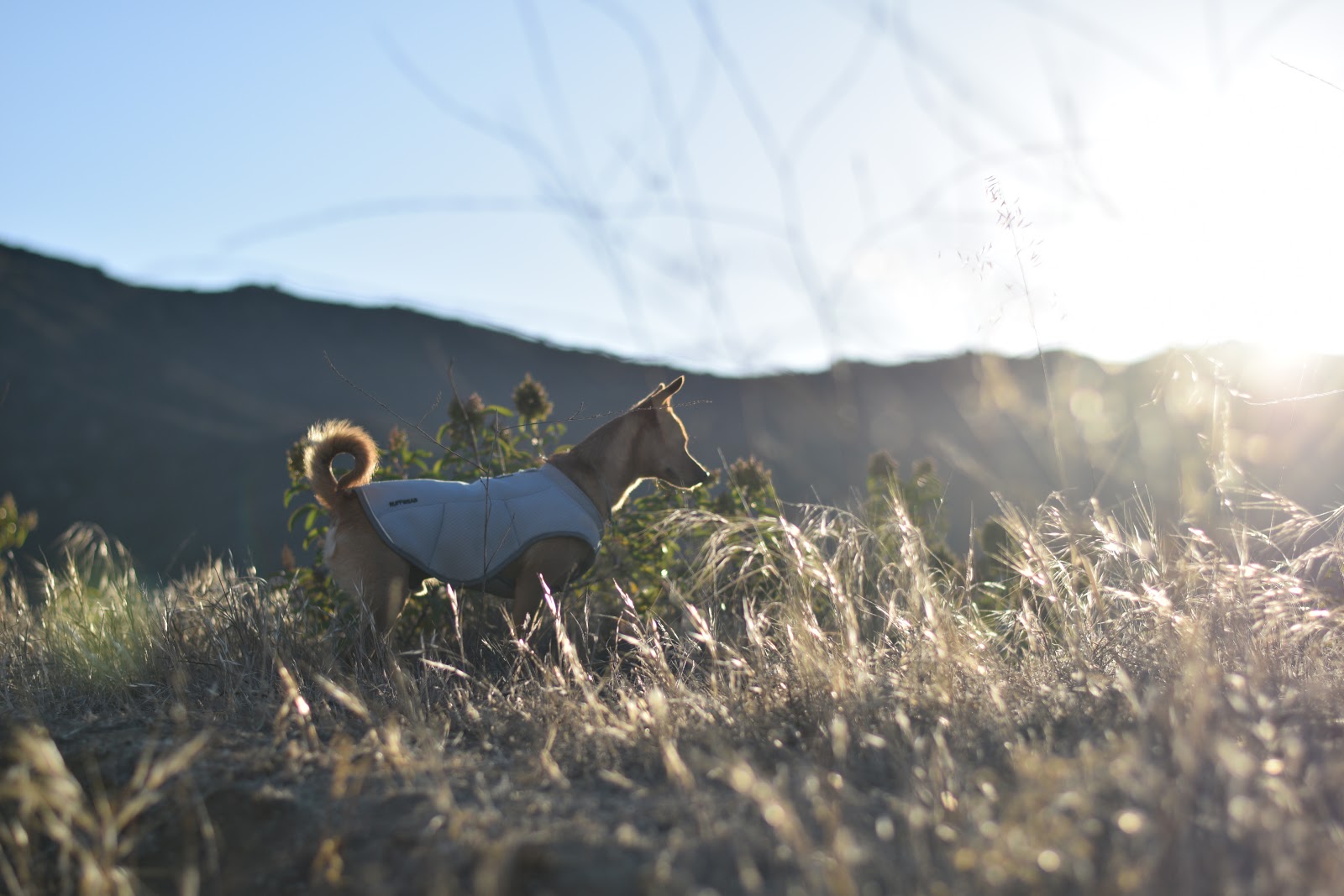
Disclaimer: I purchased this product at a discount through BackcountryK9 as a result of my relationship with them. It normally retails for $34.95 and comes in medium and large and in red, purple, blue and black.
Prior to this, I've never actually bought a leash. Robin's main leash was a length of artfully knotted paracord that he recently destroyed when I moved outside of his comfort radius. Because he has great recall and sticks close on the trail, he's generally only leashed on familiar trails when we spot another dog. So when I recently signed up to do a volunteer park cleanup, I realized I'd need a decent, hands-free leash - but I didn't anticipate how much I'd use this leash now that I have it!
Jason at BackcountryK9 made a couple of leash recommendations for me, but I picked the Roamer because of its overengineered all-metal hardware and sleek design. Robin's not a strong puller and I know we'd never break the plastic buckle on the EzyDog Road Runner (his follow-up recommendation) or similar leashes, but I like to invest once in something that will last pretty much forever. The lack of a plastic buckle at the waist also reduces the bulk when it's hand-held.
Design: 5/5
The leash is quite simple: it's a single piece of webbing with a little gray loop at one end and a sturdy winged clip at the other, and a sliding metal hook allows you to adjust from a hand loop up to a 48" waist. The waist hook fastens through the end webbing loop, which was almost impossibly tight for the first few uses. This wasn't a problem for me (I'd just loosen and step out if I ever had trouble), but the only negative reviews on Ruffwear's site complained about this. Even now that it's softened up slightly, there's zero chance of it ever unhooking itself- the hook is designed with an extra lip on the bottom that keeps the strap firmly in place. The handle is padded, which I find unnecessary but then I only use it for waist wear. The whole thing in size medium weighs 130g or 4.59 oz on my scale, which isn't extremely light but is pretty reasonable for such a substantial leash.
A generous section of the webbing is elasticized (Ruffwear calls it "Wavelength") to reduce shock on both human and dog and to extend the range. It's worth noting that the size Large gives significantly more range than does Medium - when adjusted for hand-held use, the medium stretches from 5.5' to 7', while the large stretches from 7.3' to 11' (a 50% increase). I specifically wanted the leash for times that I need Robin close, but if your dog isn't reliable off-leash or you have a larger waist, the large size might be a good option. Just bear in mind that there will be extra slack between you when your dog is close by (and if your dog is the type that gets wrapped around poles, you might be in trouble!) With the medium and my ~28" waist, there's enough extra for some flexibility but the leash can't drag on the ground.
The clip on the dog end is a hefty looking swivel winged claw clip ("Talon Clip") that's lightweight for its size. I was concerned that it would be far too heavy to attach to his lightweight martingale collar, but it actually worked fine the time I had to. Robin did some thorough yanking and twisting on the clip when I tethered him at the volunteer event after he broke the carabiner on his previous leash. He's not strong, but can be tricky with the way he twists himself up and got out of a similar clip in his early days.
I would like to see some reflectivity on the leash. It would also be nice to see some type of bypass for the stretch other than the traffic handle (which is useless with a 14" tall dog), but I can't picture how this would work without adding a lot of bulk or moving parts.
Fit: 5/5
While the hefty 3/4" size medium is definitely overkill for 17lb Robin, I actually don't find it too heavy and barely notice it around my waist. The webbing is sturdy but lightweight, and the clip is much, much lighter than it looks. I've used it on his collar several times and it doesn't seem to drag on his neck too badly. For waist leashes (where your attention is typically occupied elsewhere) it's always going to be better to use a harness to avoid jolting the neck and throat.
Function: 5/5
Previously, my issues with leashes stemmed from having one more thing to hold. My daypack has no external pockets for quick stowing, and when in use, holding the leash affected my stride when running or hiking. With this leash, I clip it on and forget about it until we see a leashed dog. Even better, I love the security of having the dog attached to my waist for all kinds of outings. I took Robin to an outdoor concert last week and enjoyed focusing on the music without thinking about keeping track of him. Next up is seeing if we can manage it and trekking poles.
One concern I had was that gaining more ground via the stretch section would encourage Robin to pull. We've worked extensively on loose leash walking and don't want to set back his training. So far, this hasn't been a problem- he doesn't really use the extra range except when he gets really excited or is sniffing off the sidewalk. However, I still imagine that this could become a problem and for that reason I make a distinction between collar use and harness use. When it's clipped to his collar, I treat it like a normal leash and expect him to slow down as soon as he feels any tension. When it's clipped to his harness (and he's less sensitive to tension in the line anyway), I am much more relaxed about him wandering as long as he doesn't trip me.
Build quality: 5/5
Like pretty much everything Ruffwear makes, it's ruggedly built and overengineered, but with streamlined style. On this style of leash, the most likely failure points are the hardware (which in this case is all-metal and extremely sturdy) and the elastic section.
Because the entire leash is one piece of webbing, with the stretch section just shirred up with internal elastic, failure is a non issue. I appreciate that there are no extra odds and ends (the EzyDog leash has an extra loop and toggle and the OllyDog version is doubled up for extra adjustability, which just means more bulk and more failure points). The Roamer keeps it simple.
Takeaways
Best for: Universally a great option for runners, hikers, or anyone that walks a dog and would like to have free hands.
Not ideal for: High-risk/high traffic scenarios where tight control is needed and extended range could be dangerous; nighttime use when range/lack of reflectivity could pose a problem, times when an ultralight/ultra packable leash would be needed.
Updates:
Dec 28: added numerical ratings.
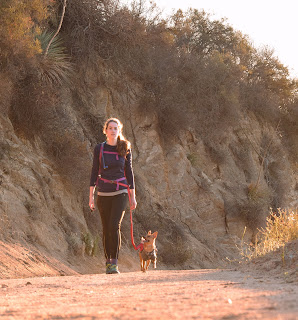 |
| The Roamer in use at sunrise. |
Jason at BackcountryK9 made a couple of leash recommendations for me, but I picked the Roamer because of its overengineered all-metal hardware and sleek design. Robin's not a strong puller and I know we'd never break the plastic buckle on the EzyDog Road Runner (his follow-up recommendation) or similar leashes, but I like to invest once in something that will last pretty much forever. The lack of a plastic buckle at the waist also reduces the bulk when it's hand-held.
Design: 5/5
The leash is quite simple: it's a single piece of webbing with a little gray loop at one end and a sturdy winged clip at the other, and a sliding metal hook allows you to adjust from a hand loop up to a 48" waist. The waist hook fastens through the end webbing loop, which was almost impossibly tight for the first few uses. This wasn't a problem for me (I'd just loosen and step out if I ever had trouble), but the only negative reviews on Ruffwear's site complained about this. Even now that it's softened up slightly, there's zero chance of it ever unhooking itself- the hook is designed with an extra lip on the bottom that keeps the strap firmly in place. The handle is padded, which I find unnecessary but then I only use it for waist wear. The whole thing in size medium weighs 130g or 4.59 oz on my scale, which isn't extremely light but is pretty reasonable for such a substantial leash.
 |
| The sturdy metal waist clip |
A generous section of the webbing is elasticized (Ruffwear calls it "Wavelength") to reduce shock on both human and dog and to extend the range. It's worth noting that the size Large gives significantly more range than does Medium - when adjusted for hand-held use, the medium stretches from 5.5' to 7', while the large stretches from 7.3' to 11' (a 50% increase). I specifically wanted the leash for times that I need Robin close, but if your dog isn't reliable off-leash or you have a larger waist, the large size might be a good option. Just bear in mind that there will be extra slack between you when your dog is close by (and if your dog is the type that gets wrapped around poles, you might be in trouble!) With the medium and my ~28" waist, there's enough extra for some flexibility but the leash can't drag on the ground.
The clip on the dog end is a hefty looking swivel winged claw clip ("Talon Clip") that's lightweight for its size. I was concerned that it would be far too heavy to attach to his lightweight martingale collar, but it actually worked fine the time I had to. Robin did some thorough yanking and twisting on the clip when I tethered him at the volunteer event after he broke the carabiner on his previous leash. He's not strong, but can be tricky with the way he twists himself up and got out of a similar clip in his early days.
 |
| The lightweight clip isn't even tightening Robin's martingale. (Tethering via collar is very much not recommended! In this case, I had to pop inside the visitor center and he could see me through the front window.) |
Fit: 5/5
While the hefty 3/4" size medium is definitely overkill for 17lb Robin, I actually don't find it too heavy and barely notice it around my waist. The webbing is sturdy but lightweight, and the clip is much, much lighter than it looks. I've used it on his collar several times and it doesn't seem to drag on his neck too badly. For waist leashes (where your attention is typically occupied elsewhere) it's always going to be better to use a harness to avoid jolting the neck and throat.
Function: 5/5
Previously, my issues with leashes stemmed from having one more thing to hold. My daypack has no external pockets for quick stowing, and when in use, holding the leash affected my stride when running or hiking. With this leash, I clip it on and forget about it until we see a leashed dog. Even better, I love the security of having the dog attached to my waist for all kinds of outings. I took Robin to an outdoor concert last week and enjoyed focusing on the music without thinking about keeping track of him. Next up is seeing if we can manage it and trekking poles.
One concern I had was that gaining more ground via the stretch section would encourage Robin to pull. We've worked extensively on loose leash walking and don't want to set back his training. So far, this hasn't been a problem- he doesn't really use the extra range except when he gets really excited or is sniffing off the sidewalk. However, I still imagine that this could become a problem and for that reason I make a distinction between collar use and harness use. When it's clipped to his collar, I treat it like a normal leash and expect him to slow down as soon as he feels any tension. When it's clipped to his harness (and he's less sensitive to tension in the line anyway), I am much more relaxed about him wandering as long as he doesn't trip me.
Build quality: 5/5
Like pretty much everything Ruffwear makes, it's ruggedly built and overengineered, but with streamlined style. On this style of leash, the most likely failure points are the hardware (which in this case is all-metal and extremely sturdy) and the elastic section.
Because the entire leash is one piece of webbing, with the stretch section just shirred up with internal elastic, failure is a non issue. I appreciate that there are no extra odds and ends (the EzyDog leash has an extra loop and toggle and the OllyDog version is doubled up for extra adjustability, which just means more bulk and more failure points). The Roamer keeps it simple.
 |
| One end of the stretch section- there is no seam, just reinforcement where the internal elastic ends. |
Overall: 5/5
I really like this leash and reach for it constantly, no matter where we're going. So far it's been perfect for hiking, concerts, walks, airport security- pretty much everything. The medium is a perfect size for keeping Robin close, and I love the red because I can quickly find it in my bag or the depths of the car. If we lost this leash I would definitely get a second one.
Best for: Universally a great option for runners, hikers, or anyone that walks a dog and would like to have free hands.
Not ideal for: High-risk/high traffic scenarios where tight control is needed and extended range could be dangerous; nighttime use when range/lack of reflectivity could pose a problem, times when an ultralight/ultra packable leash would be needed.
Updates:
Dec 28: added numerical ratings.